The Legal Side of Costa Rica
Featuring Articles Written by Oscar Hernandez, Attorney
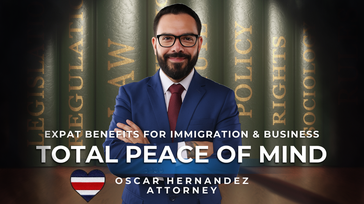
Oscar Hernandez is an Immigration Attorney
Located in San Jose, Costa Rica. He & His Team at
Expat Legal Advisors understand the needs
of the Expat who has begun a NEW LIFE in Costa Rica.
They know that the best way to enjoy the Pura Vida Lifestyle is to
have complete knowledge of the Laws of the Land. .
Understanding the Law & Living the Dream. .
Living the Pura Vida lifestyle in Costa Rica means more than enjoying its beaches, jungles and peaceful rhythm.
It means embracing a new way of life built on respect, knowledge and connection.
At Expat Legal Advisors, we believe that the more you understand the laws of the land,
the more fully and confidently you can enjoy the beauty of your new home.
These insightful articles, written by Attorney Oscar Hernández, who practices law in San José,
are designed to guide you through the legal landscape of Costa Rica with clarity and purpose.
From legal residency & real estate to healthcare & daily living, Oscar’s experience and dedication help demystify complex legal topics, empowering expats to make informed decisions
and live freely within the framework of Costa Rican law.
Knowledge is Peace of Mind. . and Peace of Mind is Pura Vida. .
Here, you’ll find practical wisdom, trusted guidance and the tools to help you thrive
as a well-informed member of Costa Rica’s expat community.

Enjoy this Article
Written Especially
for You. .
Opening a Bank Account in Costa Rica
as a Non-Resident or Resident (2026):
What Expats Should Expect Under Today’s Compliance Rules
Opening a bank account in Costa Rica as a non-resident or resident in 2026 is very possible, but it often requires more preparation than many expats initially expect. Costa Rican banks operate under strict anti–money laundering, financial transparency, and tax-reporting regulations, which means they must clearly understand who their customers are, how they earn their money, and the origin and purpose of the funds moving through the account. These requirements are rooted in national laws, supervisory rules issued by SUGEF, and international standards such as the Common Reporting Standard (CRS) and, for U.S. persons, FATCA. As a result, banks commonly request detailed identification, tax residency certifications, and documentation supporting income or assets.
Non-residents can often open accounts with a passport and proof of legal entry, while residents typically use a DIMEX, but in both cases banks apply a risk-based approach that may expand documentation requests depending on expected account activity.
During the account-opening process, banks focus heavily on the customer’s economic profile and consistency between declared activity and actual transactions. Retirees, remote workers, investors, and business owners may each be asked for different supporting documents, and large or unexpected transfers can trigger additional review if they do not match what was originally declared. Obtaining residency generally simplifies identification and helps stabilize the customer profile, though it does not eliminate due diligence or reporting obligations. Once an account is active, expats benefit from Costa Rica’s efficient local payment systems, including SINPE and SINPE Móvil, which make everyday transactions easier.
While fintech platforms can complement banking needs, they do not fully replace a local account, and corporate accounts involve even deeper compliance reviews. Overall, the process is manageable and often smooth for those who arrive prepared, understand the compliance environment, and proactively document their financial situation, turning Costa Rican banking into a practical and valuable part of daily life.
Lic. Oscar Andrés López Hernández
Attorney-at-Law
Expat Legal Advisors
When You're in Need of Legal Advice in Costa Rica,
Contact
Oscar Hernandez at
WhatsApp:
506-8543-7650
Email:
legal@expatlegaladvisors.com
Website:


Click on the Image Above
to Visit Our Website
Read More Legal Articles Here
 | ||||