The Legal Side of Costa Rica
Featuring Articles Written by Oscar Hernandez, Attorney
Oscar Hernandez is an Immigration Attorney
Located in San Jose, Costa Rica. He & His Team at
Expat Legal Advisors understand the needs
of the Expat who has begun a NEW LIFE in Costa Rica.
They know that the best way to enjoy the Pura Vida Lifestyle is to
have complete knowledge of the Laws of the Land. .
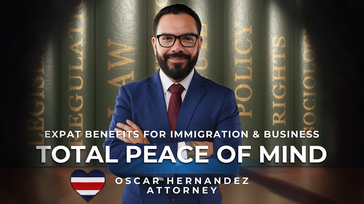
Understanding the Law & Living the Dream. .
Living the Pura Vida lifestyle in Costa Rica means more than enjoying its beaches, jungles and peaceful rhythm.
It means embracing a new way of life built on respect, knowledge and connection.
At Expat Legal Advisors, we believe that the more you understand the laws of the land,
the more fully and confidently you can enjoy the beauty of your new home.
These insightful articles, written by Attorney Oscar Hernández, who practices law in San José,
are designed to guide you through the legal landscape of Costa Rica with clarity and purpose.
From legal residency & real estate to healthcare & daily living, Oscar’s experience and dedication help demystify complex legal topics, empowering expats to make informed decisions
and live freely within the framework of Costa Rican law.
Knowledge is Peace of Mind. . and Peace of Mind is Pura Vida. .
Here, you’ll find practical wisdom, trusted guidance and the tools to help you thrive
as a well-informed member of Costa Rica’s expat community.

Enjoy this Article
Written Especially
for You. .
Costa Rica Corporations &
Exactly How They Work / Which is Best for You. .
Understanding Corporate Structures for Property Ownership in Costa Rica:
Choosing Between a S.A. & an S.R.L. .
Many newcomers to Costa Rica hear that buying property through a corporation is common—and it's true. Using a company can offer convenience, protection, and flexibility. The two most popular structures are the Sociedad Anónima (S.A.) and the Sociedad de Responsabilidad Limitada (S.R.L.). Understanding the differences helps you determine the best option for your investment and long-term plans.
S.A. vs. S.R.L.: The Basics:
Both structures can fully own property, and foreigners may own 100% of either one. They each provide limited liability, helping shield your personal assets from legal claims involving the property.
Sociedad Anónima (S.A.)
This type of corporation is similar to a traditional C-corp.
Requires at least two shareholders to incorporate.
Managed by a Board of Directors (President, Secretary, and Treasurer) plus a Comptroller.
Ownership is divided into shares, which can be freely transferred unless restricted by the bylaws.
This structure is often chosen when ownership changes may be frequent or when multiple investors are involved.
Sociedad de Responsabilidad Limitada (S.R.L.)
This structure functions more like an LLC.
Requires at least two quotaholders to incorporate.
Managed by one or more Managers (Gerentes) rather than a board.
Ownership is divided into quotas, which require formal approval and documentation for transfer.
Its simplicity makes it a popular choice for individuals or couples who own a single property.
Why Use a Corporation to Own Property?
Benefits:
Limited Liability: Helps protect your personal assets if someone is injured on your property.
Estate Planning Advantages: Shares or quotas can often be transferred more smoothly to heirs.
Convenience for Non-Residents: Utility companies and government departments may accept the corporation’s legal ID, making remote management easier.
Remote Authorizations: A corporation can grant powers of attorney for someone else to sign on your behalf.
Drawbacks:
Annual Maintenance: Corporate taxes, filings, and basic compliance responsibilities apply—even for inactive corporations.
Legal Formalities: Keeping officers, representatives, and records updated is essential.
Complexity When Selling: Buyers of a corporation may inherit the company’s debts or legal issues if proper due diligence is not done.
S.A. or S.R.L.: Which One Should You Choose?
It depends on your situation:
Choose an S.R.L. if. .
You want simplicity.
You will be the primary owner of one property.
You prefer straightforward management without a board.
Choose an S.A. if. .
You plan to have multiple partners or investors.
You want flexible transfer of shares.
You prefer a more formal corporate structure.
Both structures provide strong liability protection, so the decision often comes down to lifestyle, ownership plans, and future flexibility.
Special Note for Investor Residency:
Recent law changes require that property used for Investor Residency be purchased in the individual buyer’s name, not in a corporation. If residency is your goal, consider buying in your own name first and transferring later if needed (keeping in mind transfer taxes and related costs).
Pros and Cons Summary:
Advantages of Corporate Ownership. .
Asset protection
Easier future transfer
Possible privacy benefits
Convenience for remote management
Disadvantages of Corporate Ownership
Annual fees and tax obligations
Extra administrative steps
Compliance requirements
Personal Ownership Pros & Cons
Pro: Simple, no corporate fees or filings.
Con: Personal liability exposure and less structure for shared ownership.
Final Thoughts:
Owning property through a corporation is a popular and effective option for many buyers in Costa Rica. A S.R.L. often works best for simple, single-owner situations, while an S.A. provides more flexibility for long-term or multi-owner projects. Both structures help protect your investment and make property ownership easier to manage—especially for those living abroad.
Consult with your attorney to choose the structure that best supports your goals, lifestyle, and future plans in Costa Rica.
Lic. Oscar Andrés López Hernández
Attorney-at-Law
Expat Legal Advisors
When You're in Need of Legal Advice in Costa Rica,
Contact
Oscar Hernandez at
WhatsApp:
506-8543-7650
Email:
legal@expatlegaladvisors.com
Website:


Click on the Image Above
to Visit Our Website
Read More Legal Articles Here
 | ||||